
What Is Wisdom Tooth Removal?
Wisdom teeth — the third molars at the very back of the mouth — typically emerge between the ages of 17 and 25. For many people, the jaw simply does not have enough space to accommodate these late-arriving teeth, causing them to become impacted (trapped beneath the gum or against adjacent teeth), grow at awkward angles, or only partially emerge. This can lead to significant pain, infection, damage to neighbouring teeth, and the development of cysts or tumours around the impacted tooth.
At Smile Art Dental, wisdom tooth removal is performed by our expert oral and maxillofacial surgery team — including Dr. Okiriamu Andrew, who holds a specialist MDS in Oral and Maxillofacial Surgery (OMFS). Whether your wisdom tooth requires a simple extraction or a more involved surgical procedure for a fully impacted tooth, you are in the hands of one of Nairobi’s most qualified and experienced oral surgeons. We prioritise your comfort, using modern techniques and anaesthetic options to ensure the procedure is as smooth and painless as possible.
Following your extraction, we provide a comprehensive post-operative care pack and detailed, easy-to-follow aftercare instructions. Our team is also available to answer any questions you may have during your recovery, ensuring you heal quickly and comfortably. From your initial consultation and panoramic X-ray through to your follow-up appointment, we support you every step of the way.
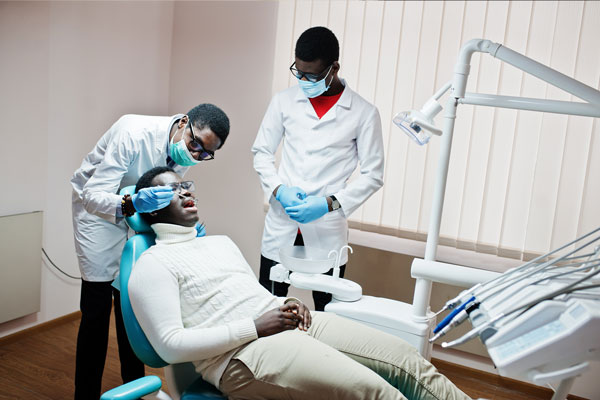
Specialist Oral Surgeon On Your Team
Our wisdom tooth removals are performed by Dr. Okiriamu Andrew (BDS, MDS OMFS) — a fully qualified specialist in Oral and Maxillofacial Surgery. His advanced training ensures even the most complex impacted wisdom tooth cases are managed with precision, safety, and minimal discomfort. You are in expert hands.
Why Remove Them
The Benefits of Wisdom Tooth Removal
Relieves Pain and Pressure
Impacted or partially erupted wisdom teeth can cause significant jaw pain, headaches, and pressure. Removal brings immediate and lasting relief from these discomforting symptoms.
Eliminates Infection Risk
Partially erupted wisdom teeth create a pocket where bacteria accumulate, leading to a painful infection called pericoronitis. Removal eliminates this recurring infection risk permanently.
Prevents Overcrowding and Shifting
Wisdom teeth pushing against adjacent teeth can cause crowding and shifting of your carefully aligned smile. Timely removal protects the alignment and spacing of your other teeth.
Prevents Cysts and Tumours
Fluid-filled cysts can form around impacted wisdom teeth, potentially damaging surrounding bone, teeth, and nerves. Early removal prevents these serious complications from developing.
The Process
Your Wisdom Tooth Removal — Step by Step
Consultation & Panoramic X-Ray
We take a full panoramic X-ray to assess the exact position, angulation, and root configuration of your wisdom teeth — giving us the complete picture needed for precise treatment planning.
Treatment Planning
Our oral surgeon reviews your X-rays, discusses the findings with you, explains the planned procedure, answers all your questions, and confirms your anaesthetic preference.
Local Anaesthesia / Sedation
The area is thoroughly numbed with local anaesthesia. For anxious patients or complex cases, IV sedation is available, allowing you to remain completely relaxed throughout the procedure.
Surgical Removal
Our surgeon carefully removes the wisdom tooth using the appropriate technique — simple elevation and forceps for straightforward cases, or surgical sectioning for impacted teeth, all with skill and precision.
Socket Management
The extraction socket is cleaned, any sharp bone edges are smoothed, and bleeding is controlled. This thorough socket management promotes clean, efficient healing and reduces post-operative discomfort.
Stitches & Aftercare Guidance
Dissolvable stitches are placed where required. You receive a post-operative care pack and thorough verbal and written aftercare instructions to ensure the smoothest possible recovery.
Frequently Asked Questions About Wisdom Tooth Removal
The procedure itself is performed under local anaesthesia, which means you will feel no pain during the extraction — only pressure and movement. Most patients are surprised by how comfortable the experience is. After the anaesthetic wears off (usually 2–4 hours later), you can expect some soreness, swelling, and mild discomfort for 2–4 days, which is very effectively managed with the prescribed or over-the-counter pain relief we recommend. Our thorough aftercare instructions help minimise post-operative discomfort significantly.
Most patients recover well within 3 to 7 days. The initial 24–48 hours after surgery involve the most significant swelling and discomfort, which then improves progressively. Simple extractions tend to heal faster than surgical extractions of impacted teeth. Full healing of the socket takes several weeks, though you will feel back to normal much sooner. Following our aftercare instructions carefully — including rest, a soft diet, avoiding smoking, and proper oral hygiene around the site — significantly speeds your recovery.
Wisdom teeth should be removed when they are causing or are likely to cause problems. Indications for removal include: impaction (teeth unable to fully emerge due to lack of space); recurrent pericoronitis (infection around a partially erupted tooth); damage or decay in adjacent teeth caused by the wisdom tooth; crowding of other teeth; the presence or risk of cysts or tumours; and significant pain or discomfort. Not all wisdom teeth need to be removed — if they erupt fully, are properly aligned, and can be kept clean, they may be monitored rather than extracted. Your dentist will advise you based on your individual X-rays and examination.
If your procedure is performed under local anaesthesia only, you may drive home yourself once you feel comfortable and are confident your reactions are unaffected. However, if you have received any form of sedation (IV sedation or oral sedative), you must not drive for 24 hours after the procedure. In this case, please arrange for a responsible adult to drive you home and, ideally, to stay with you for the remainder of the day. We will discuss this with you during your consultation so you can make the appropriate arrangements in advance.
For the first 24–48 hours, stick to soft, cool or lukewarm foods: yoghurt, smoothies (without a straw), mashed potatoes, soft scrambled eggs, soup broth, ice cream, and soft fruit. Avoid hot foods and drinks, crunchy or hard foods, and anything that requires vigorous chewing. Do not use a straw, as the sucking action can dislodge the healing blood clot and cause a painful dry socket. After 3–5 days, as your comfort improves, you can gradually reintroduce softer solid foods. You should be back to your normal diet within 1–2 weeks. Our aftercare instructions include a full dietary guide.